SFO moved more than 52 million passengers in 2024 across four terminals that don't share a baggage claim, a curbside, or a logical central meeting point — and the moment a group of 20 colleagues, 35 conference attendees, or 40 family members lands, the coordination problem starts immediately. Who's calling the rideshares? How many cars does that take?
Who waits with the luggage at Terminal 3 while two other people are still clearing customs in Boarding Area G? A San Francisco airport charter bus ends all of it in one move: one vehicle at the arrivals roadway, one group coordinator who calls the bus forward the moment every bag is in hand and everyone is assembled at the agreed door, and the whole group rolls toward downtown, the hotel, or the venue together — no scramble, no scattered ETAs, no text thread that goes six directions at once.
Below is the operational guide a trip planner actually needs: where charter buses and party buses drop off for departing groups (terminal by terminal), exactly how the arrivals pickup sequence works at each SFO terminal, the approach roads and drive times from across the Bay Area, how on-site parking costs compare to splitting a bus across your group, and what shapes the price quote. For the full picture of Bay Area group transportation services, the San Francisco airport transportation page covers one-way, round-trip, and multi-stop configurations.
Why Rent a Charter Bus or Party Bus to SFO?
The core problem with getting a group to or from SFO is that rideshares and personal vehicles don't scale. One car carries four people. Eight cars means eight separate coordination points, eight payment transactions, and eight people navigating an airport where rideshare pickups moved to Level 5 of the Domestic Parking Garage back in 2019 — a process that sends arriving passengers up an elevator and through a structure before they even reach a curb.
A San Francisco charter bus solves this cleanly: one vehicle, one pickup point at the arrivals roadway, and no one circling a parking garage trying to find the right zone letter.
BART is the other option people consider, and for solo travelers it's genuinely excellent — about 30 minutes from SFO to downtown stations like Powell or Embarcadero for roughly $11 per person, with the free AirTrain connecting any terminal to the BART station at Garage G in under 10 minutes. But for a group, the math changes quickly. Twenty-five people on BART means $275 in fares one way, everyone loaded onto a public train with full checked luggage, and a departure that runs on BART's schedule rather than yours.
A 25-person minibus to SFO from SoMa costs less per head than the same group on BART, keeps everyone's luggage together, and leaves when the group is ready — not on the hour. The breakeven point is somewhere around 6 or 8 people. Past that, the bus is almost always simpler and usually cheaper per person.
Charter Bus & Party Bus Drop-Off at SFO for Departing Groups
Drop-off at SFO follows the same pattern across all four terminals: the bus pulls to the upper/departures level curbside at the correct terminal's check-in entrance, the group unloads, and the bus exits the one-way terminal loop. The loop runs counterclockwise, approaching each terminal from the south side along the inner roadway. The single most common error for groups: dropping at the wrong terminal because the airline assignment wasn't confirmed before departure.
The four terminals don't connect inside the secured area — a wrong-terminal drop means a walk outside, an AirTrain hop, or a re-entry through security with full bags.
Terminal breakdown for departing groups: Harvey Milk Terminal 1 (the airport's newest and most celebrated facility, handling Alaska, American, Delta, JetBlue, and Porter) has a generous departures curbside on the terminal's upper roadway, accessible from the main terminal loop. Terminal 2 — Southwest, plus some United domestic flights — has a shorter, closely watched curbside where airport staff actively manage flow, so the bus should pull up, unload quickly, and move. Terminal 3 is United's domestic home, with two check-in areas (Boarding Area E at gates E1–E13, Boarding Area F at gates F1–F22) at separate ends of the building — confirm your check-in counter before the bus approaches so you target the right door.
The International Terminal, on the western end of the loop, serves international carriers in Boarding Areas A and G; its departures curbside is the longest drop-off zone at SFO and accommodates multiple large vehicles, but international groups should confirm which concourse their airline uses because A and G are physically far apart once inside.
How Charter Bus & Party Bus Pickup Works at SFO: The Arrivals Sequence
One rule governs every successful SFO group pickup: do not call the bus to the arrivals curbside until every bag is in hand and the entire group is assembled at the agreed door. The lower/arrivals level roadway at each domestic terminal is for active loading only — commercial vehicles stage in designated areas per SFO's ground transportation guidelines and move to the curb when called forward. The personal-vehicle cell phone waiting lot on North McDonnell Road is for private cars only; charter buses and large commercial vehicles are explicitly not permitted there.
The sequence is: coordinate inside baggage claim, confirm every traveler is present and bags-in-hand, designate the correct arrivals door, then make the call. At most domestic terminals that whole process takes less than a minute once the group is assembled.
Terminal-by-Terminal Arrivals Instructions
Harvey Milk Terminal 1 (Alaska, American, Delta, JetBlue, Porter). After baggage claim, exits open directly onto the T1 arrivals roadway. Curbside pickups stage on the arrivals roadway directly outside the claim area doors.
The coordinator texts the specific door number once the group is ready and the bus pulls to that door. T1 has a manageable curbside flow with reasonable spacing between arrival waves — the most straightforward domestic pickup at SFO.
Terminal 2 (Southwest, plus some United domestic flights). T2 has the shortest and most closely monitored arrivals curbside at SFO. Airport staff actively clear vehicles that linger, so the timing here is as precise as it gets at the airport: call the bus forward only when the full group is standing outside with bags, not when the last person is still at the carousel.
The bus arrives, loads in one continuous movement, and exits. Any gap between the call and the group being fully ready becomes a problem at T2's curb.
Terminal 3 (United domestic — Gates E and F). This is the terminal that catches first-timers. United's domestic gates split between Boarding Area E (gates E1–E13) and Boarding Area F (gates F1–F22), and these two areas exit at opposite ends of the Terminal 3 baggage claim hall.
A group where some people flew through E gates and others through F gates will not naturally converge at the same door. Confirm your group's gate assignments before the flight lands, designate one exit point, and have everyone walk to it before calling the bus. Trying to do two curbside stops at T3 during a busy United arrival wave is a recipe for a circling bus and a split group.
International Terminal (Boarding Areas A and G). International arrivals add customs and immigration to the equation, and the International Terminal adds its own layer: Boarding Area A (the south concourse, which connects airside to Harvey Milk Terminal 1) and Boarding Area G (the north concourse, which connects airside to Terminal 3) have separate customs exit halls on opposite ends of the building. They are far enough apart that "meet at the International Terminal" is not a plan — it's two different locations.
Confirm which boarding area your group's flight uses before the plane lands. Budget 30–60 minutes beyond touchdown for customs clearance on peak travel days with multiple wide-body arrivals. For large groups coming through the International Terminal, a meet-and-greet coordinator waiting at the correct customs exit with a name board is strongly worth arranging — both the A and G exits have dedicated greeting areas where a coordinator can wait without curbside time pressure while the group clears immigration.
The rule that keeps the curbside clean: don't call the bus forward until every person is outside with every bag. The arrivals roadway is for active loading — not staging. Coordinate inside baggage claim, assemble at the agreed door, then make the call.
At T2 especially, precision is everything. The bus moves to the curb in one motion, loads, and exits. That's the sequence that works at SFO.
Getting to SFO: Routes, Drive Times & Traffic Across the Bay Area
SFO sits about 14 miles south of downtown San Francisco in San Mateo County, and two major freeways serve it from the north: US-101 (the Bayshore Freeway, the primary spine) and I-280 (the Junipero Serra Freeway, the western scenic alternative). From downtown SF or the Peninsula, both routes funnel onto I-380 — a short connector that meets US-101 just north of the airport — and from there the South Airport Boulevard exit off US-101 takes you straight into the terminal loop. Off-peak, that's a 20-minute drive.
During the morning and evening commute, the same stretch of 101 can double the trip.
US-101 carries heavier daily load than I-280 because it's the main corridor for Bay Area tech-sector commute traffic and freight. I-280 is less exit-dense, holds a steadier flow for most of the day, and is widely regarded as the calmer approach for groups not familiar with the area — though if there's a crash, rerouting options are fewer. For a bus heading south toward SFO during the weekday morning rush, I-280 south to I-380 west to US-101 is typically the cleaner approach.
Heading north after a pickup, US-101 stacks hardest between 7 and 10 a.m. on weekdays; southbound toward SFO peaks between 3:30 and 7 p.m. Rain adds 20–40% to both windows reliably. Groups with early-morning departures should build extra buffer rather than planning on exactly meeting the off-peak estimate.
| From… | Approx. distance | Off-peak drive | Rush-hour drive |
|---|---|---|---|
| Downtown San Francisco (SoMa, Union Square) | ~14 miles | 20–30 minutes | 35–55 minutes |
| Oakland / East Bay (via Bay Bridge & US-101) | ~25 miles | 35–50 minutes | 60–90+ minutes |
| San Jose (via US-101 North) | ~36 miles | 45 minutes | 67–80 minutes |
| Palo Alto / Menlo Park (via US-101 North) | ~20 miles | 25–35 minutes | 40–55 minutes |
| Marin County / San Rafael (via Golden Gate Bridge & US-101) | ~30 miles | 55–65 minutes | 80–90+ minutes |
East Bay groups face an additional wrinkle: the Bay Bridge westbound toll applies for every vehicle crossing from Oakland toward SFO. One charter bus carrying 40 people is one toll crossing, one navigation decision, and one merge into the terminal loop — versus eight cars each paying the toll separately and sorting themselves into the correct terminal independently after an hour on the freeway together. The coordination overhead alone makes the bus the smarter move for East Bay groups past a certain size.
SFO Parking Costs vs. Renting a Charter Bus to SFO
On-site parking at SFO is expensive, and the numbers compound fast once you count how many vehicles a group actually needs. The Domestic Parking Garage and International Parking Garage charge up to $36 per day per vehicle; the Long-Term Garage runs up to $25 per day. Off-site lots can run lower but require a shuttle to the terminal that adds 15–20 minutes each way.
For current posted rates, the official SFO site at flysfo.com has the up-to-date parking table before your trip.
For a Silicon Valley company flying a 40-person team into SFO for a 3-day offsite in the city: if those 40 people drive from the Peninsula and park at the Domestic Garage, that's roughly 10 vehicles at $36/day for 3 days — $1,080 in parking alone, before gas or the Bay Bridge. A 56-passenger charter bus from the Peninsula to SFO, picking everyone up at one staging point and dropping at the group's terminal, covers all 40 for a single flat quote. The per-person economics shift decisively once you're past 8 or 10 travelers, and the group moves together instead of filtering into the airport in waves across a 45-minute window.
Ten cars at SFO's Domestic Garage for three days runs about $1,080 in parking alone. One charter bus carrying your full group covers the same run for a single flat rate — no garage tickets to split, no separate arrival times at baggage claim, and no one drawing straws for who picks up the rental cars.
Every Way a Group Gets to SFO, Compared
A private bus isn't automatically the right call for every SFO group trip — but there is a clear threshold where it beats the alternatives. Here's an honest comparison for a group of 20 or more people:
| Option | Cost shape | Arrive together? | Luggage capacity | Timing flexibility | Best for |
|---|---|---|---|---|---|
| Private charter bus or party bus | One flat rate split across the group | Yes — one vehicle, one curbside | Excellent — undercarriage bays for full groups | Full — you set pickup time and terminal | Groups of 15–56 |
| BART (SFO station via AirTrain) | ~$11 per person each way | No — public train, limited space, separate seats | Tight with multiple checked bags per person | Fixed schedule; last train around midnight | Solo travelers, pairs |
| Rideshare (Uber / Lyft) | Per car each way; surge pricing during busy waves | No — 4 people max per car | Trunk only; no undercarriage storage | Variable ETAs; Domestic Garage pickup adds 10+ min | Groups of 1–4 |
| Personal cars / rental cars | Per car/day + parking ($25–$36/day) + gas + tolls | No — separate vehicles, separate arrivals | Trunk-limited | Flexible but fragmented | 1–2 cars, short stays |
| SamTrans public bus | $2–$3 per person | No — public bus, individual seating | Difficult with checked luggage | Fixed schedule; limited late-night runs | Budget solo travel |
For 1–3 people with carry-on bags and no schedule pressure, BART wins on cost and simplicity — the AirTrain from any terminal to the Garage G BART station runs every 4 minutes and the 30-minute ride to downtown is hard to beat at $11. For 3–5 people with normal luggage, a rideshare still works. Once your group grows past 6 people, or you have full checked luggage, or a hard departure time, or you're flying into the International Terminal at 10 p.m. — the bus case makes itself.
Call 415-796-8308 or use Partybussanfrancisco.co's online form to get a quote in under 30 seconds and compare vehicle options for your exact headcount and date.
What Size Bus Does Your SFO Group Need?
Airport transfers are different from event runs — luggage volume matters as much as headcount. Here's how the full vehicle lineup stacks up for SFO airport transfers:
| Vehicle | Seats | Luggage capacity | Best for | Key features |
|---|---|---|---|---|
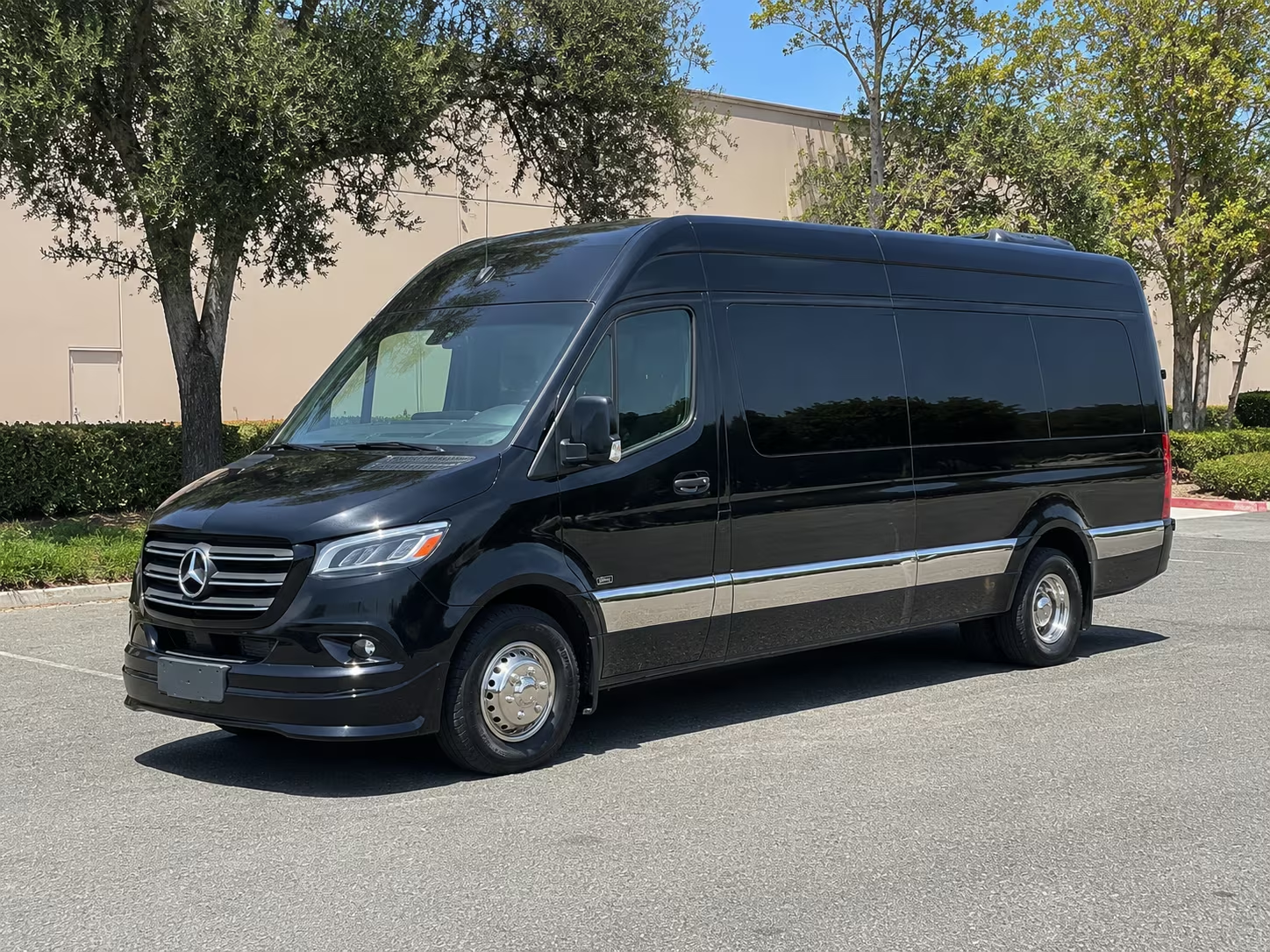
| 14-passenger Sprinter limo / Sprinter van | Up to 14 | Modest — rear and overhead storage | Executive teams, small VIP arrivals, board-level transfers | Premium leather, USB charging, tinted windows, individual reading lights |
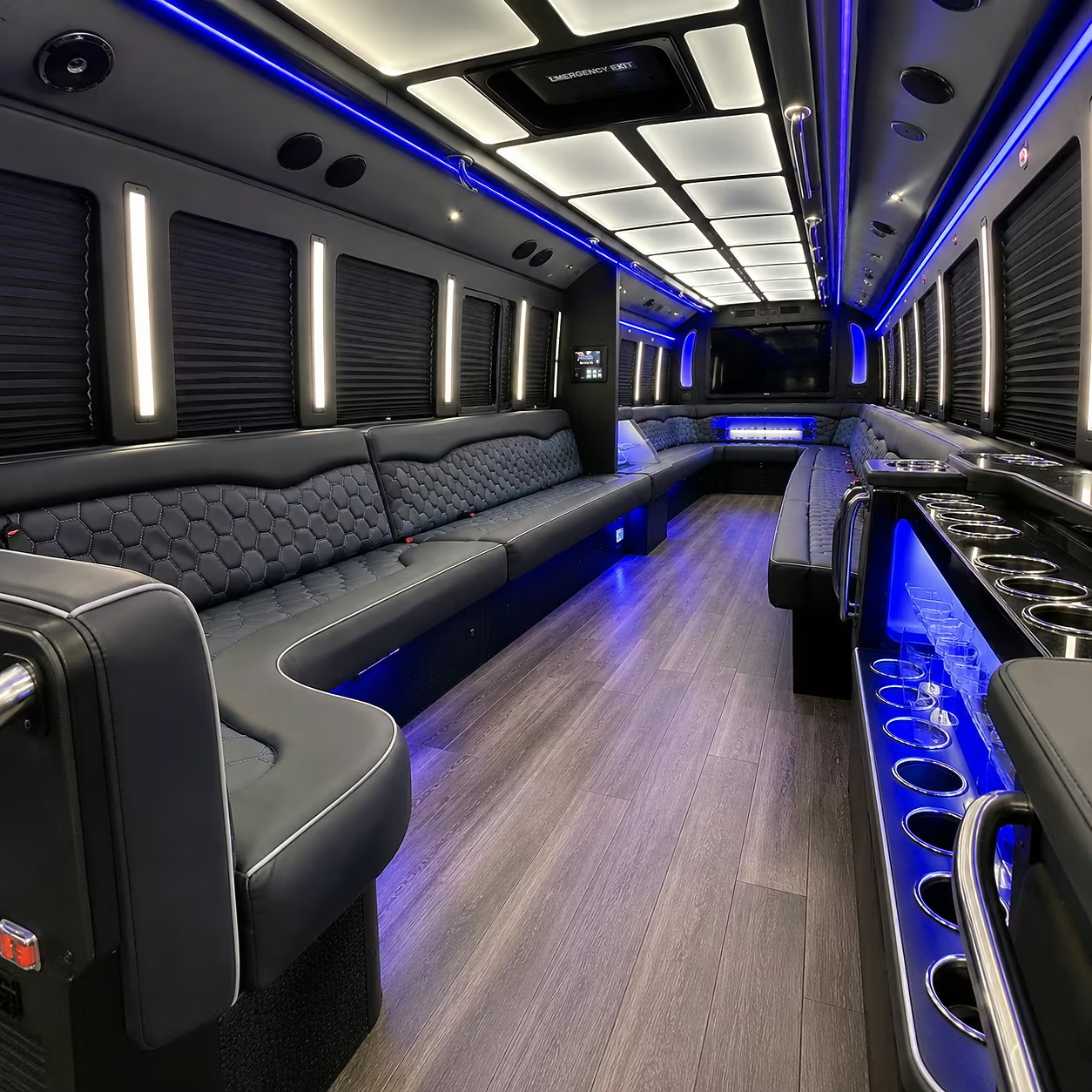
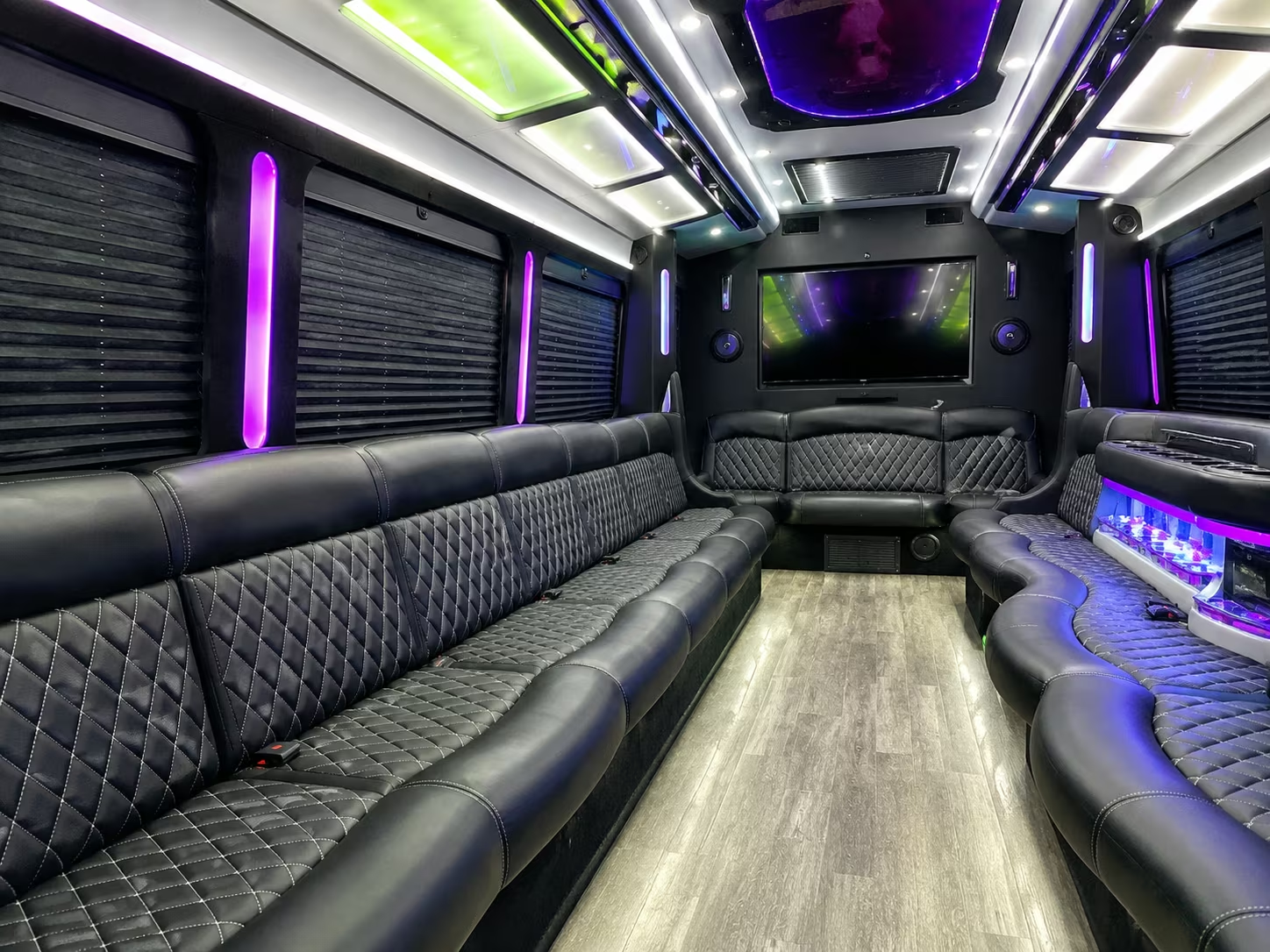
| Party bus (15–50 passengers) | ~15–50 | Some onboard; not ideal for full checked bags | Groups who want to celebrate the arrival or departure, not just transfer | LED lighting, premium sound, flat-panel TVs, perimeter seating |
| 15–35 passenger minibus | ~15–35 | Good — overhead bins plus some underfloor | Mid-size conference groups, wedding parties, sports teams with gear | Reclining seats, powerful A/C, overhead storage |
| 40–56 passenger charter bus | Up to 56 | Excellent — deep undercarriage bays | Large convention groups, full team travel, corporate delegations with equipment | Reclining seats, climate control, WiFi, power outlets, onboard restrooms, undercarriage bays |
For groups with checked bags, presentation cases, or any kind of team equipment, a full-size charter bus is the right pick. The undercarriage bays handle the kind of luggage load that fills an entire Southwest carousel. A minibus bridges the gap for groups of 15–35 with overhead bins and modest underfloor storage.
For executive and VIP arrivals, a 14-passenger Sprinter is a clean, compact fit. ADA-accessible vehicles are available through the network — note it clearly in your quote request so the right vehicle gets confirmed before travel day.
San Francisco Charter Bus Rental Prices for SFO Airport Runs
Partybussanfrancisco.co shows quotes in under 30 seconds with no account required. The rate for an SFO airport run depends on vehicle size, total hours, pickup origin, and the date. To give you an idea: a minibus for an SFO airport transfer typically runs $200–$250 per hour on weekdays, $200–$275 on weekends.
A full-size charter bus generally runs $200–$350 per hour. Party buses — with LED lighting, sound systems, and perimeter seating — run roughly $250–$500 per hour on weekends depending on capacity. These are planning ranges to give you a sense of scale; the exact quote for your date, group size, and pickup/drop-off combination comes from the online form or a call to 415-796-8308.
Final pricing varies with demand, timing, and vehicle availability — but getting a number for your specific trip takes about a minute.
The per-person math is where the bus typically surprises people. A 25-person transfer on a minibus from SoMa to Terminal 3 — say a 90-minute weekday booking at $220/hour — runs about $330 total, roughly $13 per person. That's less than BART round-trip ($22) and far less than the surge-priced Thursday-afternoon rideshare run in SoMa at 4:30 p.m.
For pricing ranges across vehicle types, the San Francisco party bus prices page has the full breakdown.
A Sample SFO Airport Run
To give you an idea: a 38-person tech team finishing a 3-day company offsite books a 40-passenger party bus for a transfer from their SoMa hotel to Terminal 3. Pickup at 4:30 p.m., at the Terminal 3 departures curbside by 5:10 p.m. — two and a half hours before a 7:45 p.m. United departure.
Everyone checks in together. The group doesn't split across nine different rideshares during a 4:30 p.m. SoMa traffic peak, and no one gets a separate surge-priced fare.
A 2-hour booking at that size might run $700–$900 total — roughly $18–$24 per person, versus the $10–$15 per-person rideshare surge that 38 individual app orders would have generated at that time and location.
Group Transportation Tips for SFO
- Confirm your terminal before the bus leaves. The four terminals don't connect inside security. A wrong-terminal drop-off means an outdoor walk, an AirTrain hop, or a re-entry through security with full bags. Confirm your airline's terminal on your ticket before departure day.
- For Terminal 3 (United), know your boarding area. Gates E1–E13 exit at one end of the T3 baggage claim hall; Gates F1–F22 exit at the opposite end. Mixed E and F arrivals don't naturally converge at the same door — pick one exit point in advance and have everyone walk to it.
- For the International Terminal, know whether you're in A or G. Boarding Area A connects airside to Harvey Milk Terminal 1; Boarding Area G connects airside to Terminal 3. The two customs exit halls are far apart. Confirm which boarding area your flight uses before calling the bus forward.
- Budget extra time for international arrivals. Customs and immigration can add 30–60 minutes beyond touchdown on busy days. Build that window into your pickup timing so the bus isn't circling the terminal roadway while your group is still in the immigration line.
- Don't call the bus to the curb until the full group is outside with bags. The arrivals roadway is for active loading, not staging. Especially at Terminal 2, where the curbside is short and closely monitored — call the bus forward only when everyone is ready to board immediately.
- For Bay Area conference season, book well in advance. Major tech events in spring (March–May) and fall (September–November) drive significant demand for group airport transfers across the Bay Area. Charter buses for large groups with checked luggage are not always available on short notice during peak weeks.
- Check current terminal assignments before travel day. Airline terminal assignments at SFO can shift, particularly around renovation phases or airline moves. Verify through your ticket or the official SFO site at flysfo.com before your group's trip.
Frequently Asked Questions About SFO Group Transportation
Where does a charter bus drop off a departing group at SFO?
Charter buses drop off on the upper/departures level curbside at the correct terminal's check-in entrance. The terminal loop is a counterclockwise one-way circuit — buses approach each terminal from the south along the inner roadway and pull to the departures curb. Terminal 2's curbside is the shortest and most closely managed, so time the drop precisely and don't hold the curb.
Confirm your terminal before departure: Harvey Milk Terminal 1 for Alaska, American, Delta, JetBlue, and Porter; Terminal 2 for Southwest and some United domestic flights; Terminal 3 for United domestic; the International Terminal for international carriers.
How does a charter bus pick up a group from SFO arrivals?
The group coordinator tracks progress through baggage claim, confirms the full group is assembled at the agreed arrivals door on the lower/arrivals level with every bag accounted for, then calls the bus to that specific door. Commercial vehicles are not permitted in SFO's personal-vehicle cell phone waiting lot — charter buses stage in commercial vehicle areas per SFO's ground transportation guidelines and move to the terminal curb only when called. Do not call the bus early; the arrivals roadway is for active loading, not staging.
What's the difference between Boarding Area A and Boarding Area G at the International Terminal?
Boarding Area A is the south concourse of the International Terminal, connecting airside to Harvey Milk Terminal 1. Boarding Area G is the north concourse, connecting airside to Terminal 3. Their customs exit halls are on opposite ends of the building — far enough apart that "meet at the International Terminal" without a specific exit point creates a coordination problem at 11 p.m. after a 10-hour flight.
Confirm which boarding area your group's flight uses before the plane lands and coordinate the exact exit point before calling the bus forward.
Why does Terminal 3 have two separate baggage claim exits?
Terminal 3 is United's domestic facility, and its two boarding areas — E (gates E1–E13) and F (gates F1–F22) — exit at opposite ends of the baggage claim hall. A group where half arrived through E gates and half through F gates won't naturally end up at the same door. The fix is simple: check everyone's gate assignment before the flights land, designate one exit, and have everyone walk to it after baggage claim before the bus is called forward.
How much does parking cost at SFO, and how does it compare to a bus?
On-site parking runs up to $36 per day at the Domestic and International garages, and up to $25 per day at the Long-Term Garage. For a group of 30 people sharing 7 or 8 cars and parking 3 days, that's $525–$864 in parking alone — before gas, tolls, or the time it takes eight separate cars to coordinate at baggage claim. A single charter bus for the same group covers everyone for one flat rate.
For current official rates, check flysfo.com before your trip.
Is BART a good option for a group going to SFO?
For 1–3 people, yes — BART runs about 30 minutes from downtown stations to SFO's BART station at Garage G for roughly $11 per person, with the free AirTrain connecting to all terminals in under 10 minutes. For groups of 6 or more, especially those with full checked luggage, BART gets complicated fast: individual fares stack up, luggage takes up space on a public train, and everyone arrives at the AirTrain platform separately. A minibus or charter bus for a larger group typically beats BART on per-person cost and is dramatically simpler on coordination.
What routes does a bus take from San Francisco to SFO?
The two main approaches are US-101 South (exit South Airport Boulevard, the direct spine) and I-280 South to I-380 West to US-101 South (the calmer western alternative that avoids the heaviest tech-corridor traffic on 101). From the East Bay, the Bay Bridge westbound connects to US-101 South. The exact approach for your group's date and time is factored in at booking — 101 and 280 perform differently depending on the hour, and 280 is often the faster option when 101 is stacked.
What airlines fly from which SFO terminal?
As of 2025: Harvey Milk Terminal 1 — Alaska, American, Delta, JetBlue, Porter. Terminal 2 — Southwest, Air Canada, Breeze Airways, WestJet, and some United domestic flights. Terminal 3 — United domestic.
International Terminal (Boarding Areas A and G) — international carriers including Air France, Lufthansa, Emirates, Singapore Airlines, British Airways, Cathay Pacific, ANA, Japan Airlines, and most international United departures. Terminal assignments can shift; confirm through your ticket or at flysfo.com before travel day.
When should I book a charter bus for SFO to get the best availability?
For most dates, 2–4 weeks of lead time is workable. For large groups — 40 or 56 people with checked luggage — or for trips tied to major Bay Area events like large tech conferences in spring or fall, book as soon as your travel dates are confirmed. The right vehicle for a full-size group airport transfer isn't always available on short notice.
Call 415-796-8308 any time and a quote comes back in about 30 seconds; no account required, no obligation.
Are ADA-accessible buses available for SFO group transfers?
Yes — ADA-accessible vehicles are available through the network. Note your needs clearly in your quote request so the correct vehicle is confirmed before the trip. At SFO, accessible drop-off and pickup curbs are available at all four terminals, and the AirTrain is fully accessible between terminals and between any terminal and the BART station at Garage G.
Book Your SFO Charter Bus or Party Bus Today
Whether it's a 14-person executive team transferring from a Palo Alto hotel to Terminal 2, a 40-person conference delegation landing at the International Terminal, or a full team of 56 flying home after a company event — Partybussanfrancisco.co makes it fast to find and compare charter bus and party bus options serving San Francisco and the entire Bay Area. Fill out the quick online form and see pricing in under 30 seconds, or call 415-796-8308 any time to run through vehicles and build a quote around your exact headcount, terminals, and timing. No account required, no obligation, and no calling six transportation companies to describe your trip from scratch.
Planning a game or a show in the city after the group lands? The same network covers Chase Center for Warriors games and concerts and Oracle Park for Giants games — airport-to-venue itineraries are easy to build into a single quote.